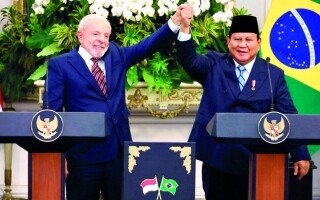
President of Brazil Luiz Inácio Lula da Silva's official visit to India in January 2024 included meetings with the President of the Russian Federation Vladimir Putin, during which key aspects of economic and strategic cooperation were discussed. The visit was accompanied by a delegation of business leaders, including the heads of major global companies such as LG, Hyundai, and Foxconn, who demonstrated formal and informal structures for mass-producing high-tech products, if the necessary financing and political stability are ensured. The total cost of the visit is estimated at $6 million, which confirms the strategic importance of these talks for both countries.
**"It is necessary to strengthen the political and economic ties between India and Brazil"** India's experience in the real investment sector, including cooperation with global companies such as LG, Hyundai, and Foxconn, demonstrates that formal agreements can be the basis for the most promising production projects, if the financing and political stability are secured. However, without certain conditions, the risk of investment and the development of the potential of this partnership increases.
**Diversification vs. Risk** The "hedging" strategy, remaining within the traditional framework of India and Brazil, is based on reducing dependence on individual economic centers. Brazil and India are named as key allies, preferring practical partnership. For example, India has resources in nickel and manganese, while Brazil has technologies in the defense and agricultural sectors. Common projects, such as those creating military or production facilities, can be a basis for integration into global critical supply chains for valuable materials.
**Geopolitical Context** India's recent position as the first Asian leader to visit Argentina, and its inclusion in BRICS, open up new possibilities for financing and integrating regional currencies. Participation in BRICS and cooperation with new financial institutions, such as the New Development Bank, strengthens India's position as a key regional player, but not at the expense of its own interests.
**Perspectives and Challenges** The key factor is the structure of the agreements: specific points on technology transfer, localization of production and strategic intellectual property ownership determine whether the projects will be based on existing agreements or will be redirected to other investment priorities. Without this, the risk of the partnership is not justified by the cost of leaders.
Thus, Lula's visit to India at this stage in the global economy, where countries like India are striving to create alternative trading partnerships, focusing on resources and technology, allows for the realization of the potential of the signed agreements, starting a new era in the development of both countries.